The Gut-Brain Connection
Your “second brain” has 500 million neurons. When gut and brain miscommunicate, everything suffers. Understanding this connection is the key to healing.
Your gut doesn't just digest food. It thinks. It feels. It communicates. And when that communication breaks down, everything breaks down with it.
The gut-brain connection isn't metaphor—it's anatomy. And understanding how it works is the foundation for treating everything from IBS to anxiety to chronic pain.
Are You Hypnotizable?
Find out in 60 seconds
Hypnotizability Assessment
Adapted from the Stanford & Tellegen clinical scales
When reading a book or watching a movie, do you get so absorbed you lose track of time?
For decades, medicine treated the gut as a simple food-processing tube. We now know it's far more sophisticated—a “second brain” with its own nervous system, producing neurotransmitters, and in constant bidirectional communication with the brain in your head.
This discovery has revolutionized how we understand and treat a huge range of conditions. Because when the gut-brain connection works well, you feel calm, digest properly, and think clearly. When it doesn't? Anxiety, digestive chaos, brain fog, and problems that seem unconnected but share a common root.
What This Guide Covers
- What the gut-brain connection actually is
- The three communication pathways
- Why this matters for your health
- How the anxiety-gut cycle works
- How hypnotherapy heals the connection
- Who benefits most from this approach
What Is the Gut-Brain Connection?
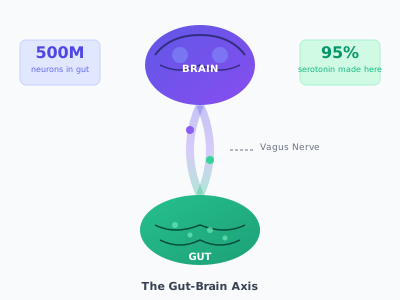
The gut-brain axis is a bidirectional communication network linking your gastrointestinal tract to your central nervous system. It's not a single connection—it's an entire superhighway of signals flowing in both directions, 24 hours a day.
Your gut contains more neurons than your spinal cord—a complete nervous system called the enteric nervous system or 'second brain.'
Source: Furness JB, The enteric nervous system, Blackwell Publishing, 2006
What makes this connection so important? It's bidirectional. Your brain affects your gut (that's why stress causes stomach problems), but your gut also affects your brain (that's why gut issues cause anxiety, depression, and brain fog).
This two-way street means you can't fully treat gut issues without addressing the brain, and you can't fully treat certain brain issues without addressing the gut. It's why so many people struggle—they're only treating half the problem.
The Three Communication Pathways
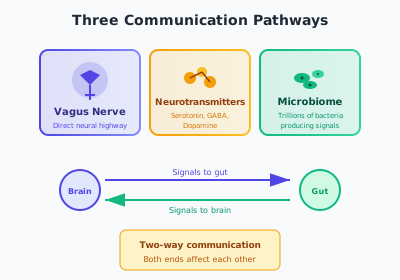
The gut and brain communicate through three main pathways, and understanding these helps explain why hypnotherapy is so effective at healing this connection:
A direct neural superhighway connecting gut and brain. It carries signals in both directions—90% going UP from gut to brain. This is why gut issues cause mood changes.
Your gut produces 95% of your body's serotonin, plus GABA, dopamine, and other brain chemicals. The gut literally manufactures your mood.
Trillions of bacteria in your gut produce chemicals that cross into your bloodstream and directly affect brain function, mood, and cognition.
Why This Matters for Your Health
Here's what the research has discovered—and it changes everything we thought we knew about chronic conditions:
Studies show gastrointestinal distress often precedes mood disorders—not the other way around. Fix the gut, fix the mood.
Chronic stress alters gut permeability, motility, and microbial composition. Your thoughts literally reshape your digestive system.
Certain gut bacteria produce neurotransmitters that directly influence brain fog, focus, and mental clarity.
The two-way connection means treating gut issues can heal anxiety, and calming anxiety can heal gut issues.
This is why treating digestive issues as “just a stomach problem” so often fails. And why treating anxiety as “just a mental health issue” misses half the picture.
“The discovery that the gut-brain axis is bidirectional has fundamentally changed how we approach treatment. You cannot fully heal one without addressing the other.”
Struggling with the gut-brain connection?
See if hypnotherapy could help restore balance.
Apply to Work With Me →The Anxiety-Gut Symptom Cycle
One of the most destructive patterns in gut-brain dysfunction is the anxiety-symptom cycle. Here's how it works:

- Stress or anxiety triggers a gut response (the brain signals danger)
- Gut symptoms appear — pain, bloating, urgency, nausea
- You become vigilant — constantly monitoring for symptoms, worrying about the next episode
- This vigilance creates more stress — which triggers more gut symptoms
- The cycle intensifies — each round making it worse
This is why people with gut issues often say: “It started after a stressful event, but now it won't stop even when I'm not stressed.” The cycle has become self-sustaining. The gut has become hypersensitive—interpreting normal sensations as painful.
How Hypnotherapy Heals the Connection
Gut-directed hypnotherapy is one of the most well-researched treatments for gut-brain dysfunction. It works by accessing both ends of the axis simultaneously:

Experience significant improvement in symptoms, with benefits often lasting years after treatment ends.
Source: 40+ years of clinical research, NHS-recommended
During hypnosis, direct suggestions can:
- Calm vagal tone — Activating the “rest and digest” parasympathetic system
- Reduce visceral hypersensitivity — Teaching your gut to interpret normal sensations normally
- Break the anxiety-symptom cycle — Stopping the fear of symptoms from creating more symptoms
- Improve gut motility — Normalizing how your digestive system moves
This isn't alternative medicine speculation. Brain imaging studies show hypnotherapy changing how the brain processes gut signals. The visualizations create real neurological changes.
Who Benefits Most from This Approach?
Hypnotherapy targeting the gut-brain connection works best for people who recognize the mind-body nature of their symptoms.
You're a Good Fit If:
Consider Other Options First If:
Investment Options
I offer three ways to work with me, depending on your needs and budget. The research shows that both 1:1 sessions and audio programs produce results—the key is consistency and practice.
Investment & Options
Choose the path that fits your needs
Cost Per Session Comparison
~$300/session for 6 personalized sessions
- 6-8 personalized sessions
- Custom to your triggers
- Direct support throughout
Best for complex cases or trauma-related eating
ApplyJust $37/session — same content, 10x less cost
- 6 full sessions (same content as 1:1)
- Self-paced, repeat anytime
- Lifetime access forever
30-day satisfaction guarantee. Not for you? Full refund.
$350 for one 45-min session
- One 45-min session
- No program structure
Just want to see what it's like
Inquire via EmailFrequently Asked Questions
Is this just “all in my head”?
No. The gut-brain connection is physical anatomy. 500 million neurons, real neurotransmitters, measurable changes on brain scans. It's not imaginary—it's neuroscience.
How long until I see results?
Most clients notice some improvement by sessions 3-4. Significant changes typically occur by sessions 6-8. Full benefits develop over the complete program.
Will I still need dietary restrictions?
Many clients find their tolerance for trigger foods improves significantly. The goal isn't to abandon all management, but to reduce hypersensitivity so normal eating becomes possible.
Do virtual sessions work?
Yes. Virtual hypnotherapy is just as effective as in-person. Many clients prefer the comfort and convenience of sessions from home—especially when gut issues are involved.
Are there any side effects?
No. Hypnotherapy is non-invasive with no side effects. The only “side effect” is usually feeling deeply relaxed—many clients say it's the most relaxed they've felt in years.
Do I need a diagnosis first?
I recommend seeing a gastroenterologist first to rule out organic disease. Once functional issues are confirmed, hypnotherapy becomes the ideal next step.
Key Takeaways
Ready to Heal the Connection?
The gut-brain connection isn't a weakness—it's a treatment target. Once you understand that your symptoms have a neurological basis, you can address them at the source.
You don't have to keep managing symptoms while ignoring the root cause. You don't have to keep treating gut and brain as separate problems.
You deserve to feel at peace in your own body.
— Danny
Ready to Get Started?
- Free application to see if we're a good fit
- 100% virtual sessions from anywhere
- Evidence-based gut-directed hypnotherapy
- Personalized to your specific symptoms
📅 Currently accepting 4 new weight loss clients per month

David Doyle
Probably the only credentialed fraud examiner for Fortune 100 companies turned Clinical Hypnotherapist on the planet. After 10+ years investigating high-profile corporate deception, Danny now applies that same ruthlessly analytical mindset to something more rewarding: helping people stop deceiving themselves. He specializes in gut health, anxiety, and pain reduction.
Last updated: January 2026
Sources & Further Reading
- •Mayer EA. The Mind-Gut Connection. Harper Wave, 2016.
- •Furness JB. The Enteric Nervous System. Blackwell Publishing, 2006.
- •Whorwell PJ, et al. Controlled trial of hypnotherapy in the treatment of severe refractory irritable-bowel syndrome. Lancet. 1984;2(8414):1232-4.
- •Lowén MBO, et al. Effect of hypnotherapy and educational intervention on brain response to visceral stimulus in IBS. Aliment Pharmacol Ther. 2013;37(12):1184-97.
- •Cryan JF, Dinan TG. Mind-altering microorganisms: the impact of the gut microbiota on brain and behaviour. Nat Rev Neurosci. 2012;13(10):701-12.