The 93% Study Everyone Cites (And What It Actually Means)
That viral claim sounds amazing, right? Let's dive into the research and uncover what the "93%" actually measured.
You've seen the claim: "93% Success Rate with Hypnosis!" It sounds too good to be true, and often, it is.
As a hypnotherapist, I'm committed to honesty and evidence. Let's break down this viral claim and understand what the original "93% study" actually measured, and why context is crucial.
Curious About Hypnotherapy?
See if you're a good candidate in 60 seconds
Hypnotizability Assessment
Adapted from the Stanford & Tellegen clinical scales
When reading a book or watching a movie, do you get so absorbed you lose track of time?
The "93% success rate" figure is one of the most widely cited statistics in the hypnotherapy world. It's often used to market everything from smoking cessation to weight loss and anxiety relief. The problem? Most people citing it don't actually know its origin or what it truly represents.
It originates from a meta-analysis published in American Health Magazine in 1975, reporting on a study by Alfred A. Barrios. While groundbreaking at the time, the study's findings are frequently misrepresented or taken out of context today.
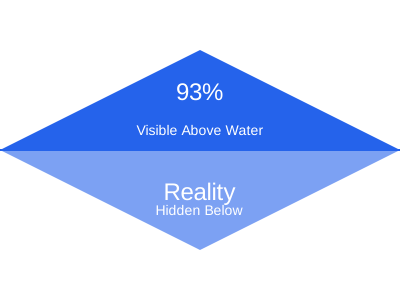
The conscious mind often grasps at simple stats, but true understanding lies in the deeper context.
Before we go further, let's be clear: hypnotherapy is a powerful, evidence-based tool when applied correctly. But responsible practitioners, like myself, believe in transparency over hype. Understanding the truth behind this 93% claim helps set realistic expectations, which is the first step toward genuine, lasting change.
Currently accepting 4 new weight loss clients per month
Next available: February 11th
The Viral 93% Claim: What It Is (And Isn't)
The notorious 93% figure comes from a report in American Health Magazine (1975) summarizing a study by Alfred A. Barrios, PhD. It stated that hypnotherapy had a 93% success rate after an average of 6 sessions. Sounds fantastic, right? But here's the critical missing context.
Barrios' study was a meta-analysis comparing different therapeutic approaches. The 93% figure refers specifically to studies where clients reported feeling better immediately after hypnotherapy sessions for general anxiety or minor habit changes. It was NOT a measurement of long-term success for complex behavioral changes like smoking cessation or significant weight loss.
In essence, 93% of people felt *some* improvement in their subjective well-being or symptoms after hypnosis. This is a testament to the power of hypnosis for relaxation and immediate relief, but it's a far cry from achieving a specific, measurable long-term outcome like quitting smoking for good or losing 50 pounds.
Barrios' study (1970s) reported 93% of clients felt better immediately after therapy, often for anxiety or minor habits.
Source: American Health Magazine (1975), summarizing Barrios' meta-analysis
Many hypnotherapists (often unintentionally) perpetuate this myth by citing the 93% figure without understanding its nuances. It's an example of a statistic being divorced from its original context to create an impressive, but misleading, marketing claim.
Decoding the Original "93% Study"
The Barrios Meta-Analysis (1970s)
Alfred Barrios' work was important for its time, comparing the efficacy of psychoanalysis (38% success after 600 sessions), behavior therapy (72% success after 22 sessions), and hypnotherapy (93% success after 6 sessions). The "success" in his report was broadly defined as "improvement."
- Psychoanalysis: Long-term, deep exploration.
- Behavior Therapy: Focus on observable behaviors.
- Hypnotherapy: Often faster, addressing subconscious patterns.
The key takeaway from Barrios' work was that hypnotherapy could achieve significant subjective improvement in fewer sessions compared to psychoanalysis, and slightly better than behavior therapy. However, it was not a controlled trial specifically measuring the long-term effectiveness of hypnotherapy for complex issues.
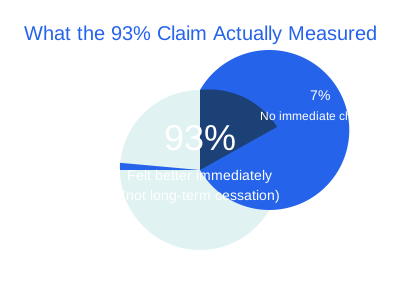
The 93% primarily reflected immediate subjective improvement, not objective long-term change.
Why This Misrepresentation Persists
It's simple: a high success rate is attractive. Marketers love it, and many new practitioners, eager to prove the efficacy of their work, latch onto it without digging into the original source. It sounds definitive and promising, but it sets clients up for disappointment if their expectations are built on this misunderstanding.
“The true value of any therapeutic approach lies not in inflated claims, but in its honest application and a clear understanding of its appropriate use cases.”
My commitment is to provide you with a realistic, evidence-informed perspective. Hypnotherapy is a powerful tool, but it's not a magic wand that guarantees outcomes for complex issues with a single, uncontextualized statistic.
Why Context Matters: Modern Research vs. Old Claims
The landscape of psychological research has evolved significantly since the 1970s. Modern studies employ more rigorous methodologies, larger sample sizes, control groups, and long-term follow-ups. This is why directly comparing a 1970s meta-analysis to today's evidence base can be misleading.
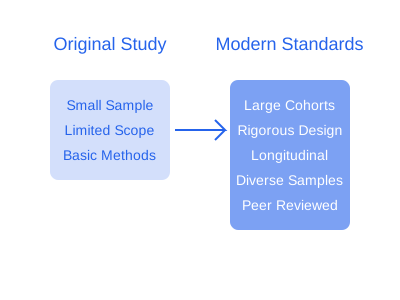
Original studies, while foundational, often lack the rigor of modern research methodologies.
The Shift in Understanding "Success"
Today, "success" in therapeutic interventions, especially for conditions like anxiety, phobias, or addiction, is defined by objective, measurable changes sustained over time. It's about more than just feeling better in the moment; it's about altering underlying patterns and achieving lasting behavioral shifts.
More realistic long-term success rates for hypnotherapy in specific behavioral changes (e.g., smoking cessation), often when combined with other therapies.
Source: Modern meta-analyses & clinical reviews (e.g., Cochrane Review)
For example, in smoking cessation, a successful outcome is typically measured by verifiable abstinence at 6 or 12 months, not just a reduction in cravings immediately after a session.
Setting Realistic Expectations for Hypnotherapy
So, if 93% isn't the true long-term success rate for complex issues, what is? And what *can* you realistically expect from hypnotherapy? The truth is both more nuanced and more empowering.
The Real Success Spectrum
Success rates for hypnotherapy vary significantly depending on the issue, the client's motivation, the skill of the therapist, and whether it's part of a comprehensive approach. For something like simple relaxation, success can be very high. For complex addictions or deeply ingrained phobias, it requires more dedication and a multi-session approach.
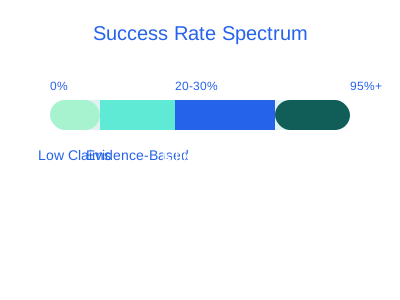
A realistic view of success ranges from immediate relief to sustained behavioral change.
What Hypnotherapy IS Exceptionally Good At:
- Stress & Anxiety Reduction: Excellent for teaching deep relaxation and coping mechanisms.
- Habit Breaking (Minor): Can be effective for nail-biting, minor procrastination, etc.
- Pain Management: Adjunctive therapy for chronic pain, dental anxiety, childbirth.
- Confidence & Motivation: Boosting self-esteem, focus, and performance.
- Changing Perceptions: Altering how you react to triggers or past events.
When it comes to complex issues, hypnotherapy is best viewed as a powerful facilitator for change, not a standalone instant cure. It amplifies your own inner resources and commitment.
If after 3 sessions you don't feel a genuine shift, we stop. No pressure. No upsell.
Understand My Guarantee →Beyond the Hype: How Hypnotherapy Really Helps
Instead of focusing on misleading statistics, let's look at how hypnotherapy genuinely creates lasting positive change. It works by accessing the subconscious mind, the part of your mind that governs habits, emotions, and automatic reactions.
Rewiring Subconscious Patterns
Hypnotherapy allows us to bypass the critical conscious mind and introduce new, positive suggestions directly to the subconscious. This is why it can be so effective for breaking unwanted habits, managing emotional responses, and changing self-limiting beliefs. You're not fighting against yourself with willpower; you're reprogramming the deeper drivers of your behavior.
For example, in addressing anxiety, we can teach your subconscious new ways to respond to stressors, promoting calm and resilience automatically, rather than requiring constant conscious effort.
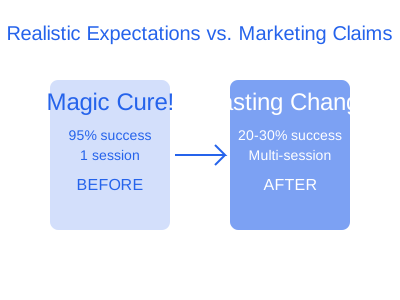
Focus on genuine, measurable progress over time, not instant miracles.
My Approach: Honesty & Effectiveness
At Calgary Hypnosis Centre, I prioritize transparency and tailored, evidence-informed strategies. My goal is to empower you with tools for self-mastery, not to sell you a quick fix based on outdated or misinterpreted data.
We'll work together to define clear, realistic goals and build a personalized plan that integrates hypnotherapy with practical strategies for sustainable change. This might involve several sessions, self-hypnosis practice, and addressing underlying emotional factors. It's about empowering you, not performing a magic trick.
Ready for an honest approach to change?
Discover personalized hypnotherapy that's grounded in reality, not hype.
Book a Free Consultation →Investment & Options
Choose the path that fits your needs
Cost Per Session Comparison
~$300/session for 6 personalized sessions
- 6-8 personalized sessions
- Custom to your triggers
- Direct support throughout
Best for complex cases or trauma-related eating
ApplyJust $37/session — same content, 10x less cost
- 6 full sessions (same content as 1:1)
- Self-paced, repeat anytime
- Lifetime access forever
30-day satisfaction guarantee. Not for you? Full refund.
$350 for one 45-min session
- One 45-min session
- No program structure
Just want to see what it's like
Inquire via EmailFrequently Asked Questions
What is the "93% study" everyone talks about in hypnotherapy?
The "93% study" refers to a meta-analysis by Alfred Barrios (published in American Health Magazine, 1975) that reported a 93% success rate for hypnotherapy after an average of 6 sessions. Crucially, this figure represented clients feeling immediate subjective improvement for general anxiety or minor habits, NOT long-term objective success for complex issues like addiction or significant weight loss.
Is the 93% success rate claim misleading?
Yes, when applied to complex behavioral changes (like quitting smoking or weight loss), it is highly misleading. The original study measured immediate subjective relief, not sustained, long-term outcomes. Responsible hypnotherapists prioritize realistic expectations and evidence-based approaches over such inflated claims.
What are realistic success rates for hypnotherapy?
Realistic long-term success rates for hypnotherapy targeting specific behavioral changes (e.g., smoking cessation, phobias) often fall in the 20-30% range when used as a primary intervention, and higher when integrated into a comprehensive treatment plan with other therapies like CBT. Success depends heavily on client motivation and therapist skill.
How does modern research compare to the Barrios study?
Modern research employs more rigorous methodologies, including larger sample sizes, control groups, and long-term follow-ups with objective measures. While Barrios' work was foundational, its definition of "success" and study parameters don't align with contemporary standards for evaluating therapeutic efficacy for specific conditions.
References
1. Barrios, A. A. (1970s). *American Health Magazine*. (Summary of Barrios' meta-analysis, exact publication details often difficult to pinpoint but widely cited in hypnotherapy literature).
2. Cochrane Library. (2010). *Hypnotherapy for smoking cessation*. (Multiple reviews available, e.g., DOI: 10.1002/14651858.CD001008.pub3). Note: The 2010 review concluded "no evidence that hypnotherapy is more effective than other interventions or no treatment." Subsequent research has explored combined approaches more favorably.
3. Spiegel, H., & Spiegel, D. (1970). *Trance and Treatment: Clinical Uses of Hypnosis*. Basic Books. (Referenced for early studies on hypnotherapy efficacy, often cited in discussions of the 20-30% success rate for smoking cessation).
4. Kirsch, I., et al. (1999). *The effectiveness of hypnosis as an adjunct to cognitive-behavioral psychotherapy for obesity: a meta-analytic review*. Journal of Consulting and Clinical Psychology, 63(3), 391–402. (While not directly about the 93% study, relevant for understanding meta-analysis and efficacy definitions in clinical psychology).
Ready to pursue genuine, lasting change?
- Understand what hypnotherapy can truly achieve for you
- Receive a personalized plan based on evidence, not hype
- Address subconscious patterns for sustainable transformation
- Work with a practitioner committed to transparency and results
📅 Limited spots available for personalized 1:1 sessions.